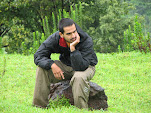
This winter morning seemed to be a blessing in disguise. Having lost several such weekday mornings this chilli winter to slumber, today I woke up with the sun rise.
I left Mariam sleeping (for which I had to pay, but that later) and went cycling.
We have a two type cycling plans, one for the weekdays and the other for the weekends. The weekday ones haven’t happened for quite sometime, while the weekend cycling is very much alive, where we cruise out of town.
Our weekday circuit takes us through a big village and then onto a road parallel to the Kuankhai river on one side and a canal on the other. Along the canals’ other bank are several small villages that stretch for the next 5 kilometres before hitting the highway perpendicularly. The outer half of the village is called the stinker, for these guys have something for the roads which they beautify with their nature call routines all along.
It was a chilli morning with the temperatures having come down to record levels, my hands and knuckles cold to the core, felt quite brittle. This was not going to stop me; the sleep is a bigger hurdle than any that I’ve faced in my life.
As I passed through the first village, there was not much of activity noticeable except for the local kiranawala and a laundry shop that catered to our colony.
Today somehow I felt not in touch with nature, as if the distance had increased over the days of my no-show. I however took to the Kuankhai river road still occupied with this thought although wanting to do a fast warm-up lap. My only companions were the stealthy babblers who are almost everywhere amongst the foliage and vegetation but only if you can catch their surreptitious movements. They are also called the ‘seven sisters’ since they are always found in the mentioned numbers. They are single coloured pretty birds who can scare you by their deadly looks. Never look into their eyes or they may bite you, had they any teeth. As I whizzed past the flora, there was not much that I could get a glimpse of better than the drongos who are black, in fact they describe the word black very well, blacker than the black, a beautiful glazy black, you cannot miss them. They are found on high wires, electric poles, tree tops; you can surely identify them by their forked tail. You can try and get close to these birds for they are urban bred and do not shy away that easily. Mostly perched on electric wires, they help clean up your streets. Observe them catch a fly or any small little flying insect with an expertise surely written into their genes.
As I turned to head back, I noticed billu in a flock, billu as in open billed stork, biggest Arial species visible in Bhubaneswar skies, about to make a landing on the other side of the river. They resemble the flying pterosaurs from Jurassic park in the way they make a landing and in many other ways such as their appearance. Surely someone in Hollywood has been inspired by their flight pattern; let me try describing to you their descent. The flock makes long circles around an identified patch of their possible landing and then slowly shifts their circular jig in the direction of their initial flight, in the same time gradually making their descent. They take their time and I mean it, landing in succession with lot of grace and harmony.
Proceeding ahead I made an abrupt stop by a neem tree by the road on the riverside upon hearing for the first time in two years the full call of one of the most shy and strikingly beautiful birds, the golden oriole. As the name says it all, the oriole is completely golden with one species having a touch of black, making it the winner of the most beautiful bird prize; their call is something like ‘pee-loo-loo’. She is most visible in winter and the trees of her choice are huge and dense trees like siris, peepal and banyan. All winter I have been spotting her with as much excitement as watching a new born baby; and have heard her regular call of ‘twue’, but today I was lucky to hear her sing.
I descended towards a patch of land on the river to first observe the winter ducks visible at a distance at the opposite riverbank. They were a first in this area. Not much was visible, even difficult to identify their colour and type; for glancing towards eastern side with the sun rising, was causing me to squint and all who have ever clicked a photo will tell you this ki it is not possible to get a good picture of the subject with his back to the sun, and the same is valid for the naked eye especially at distances.
I headed back to seek out my favourite golden oriole. I stood still, facing the canal side observing for movements on the trees by the road. There was a siris tree which surely would have initially lured the bird, and if I lingered long enough, I would surely get to see more than I asked for.
All of a sudden Nature unfolded unto me. It was like a world once invisible, was gradually revealing unto me its treasures. The surroundings quite peaceful and serene, I could now sense a lot of life here. With a little more concentration, I could now notice faint signs of flutter everywhere.
I spotted a woodpecker, a flameback carving a hole in a broken and dead portion of a tree trunk, a first ever in these lands. Then on the dried canal were perched two female koels about who nobody ever speaks, they are grey with polka dots all over and are very beautiful up close, but sadly only their male counterpart is much spoken of; or then you would have heard about the koel story just like the one in the movie ‘3 idiots’.
Then of course I spotted her, not just her but a pair and they were strikingly beautiful. It was a pair of black-hooded golden oriole. They were so strikingly beautiful, clearly visible with the sun at my behind, accentuating their varied colours. As I stood still, they carried on with their chores while I enjoyed God’s magical creations. This sisis tree was full of life with drongos, koels, babblers and bulbuls, with swallows flying high up and all this and more awaits the seeker, by an untrodden road.
And then I spotted a barbet which flew to a bush up-close. I was about to get to my bike when I sighted her on bare of-branch. What a rare sight, its colours visible in full, varied greens, a brown-headed barbet it was. These ones we can spot only on high dense trees, but this was my lucky day, I got to see her in lateral view and then it flew.
I headed back riding with verve, stopped again by another ‘twue’ and was lucky to get a passing glimpse of a flying Eurasian Golden Oriole. These ones have a little black on their wings and come with a regular pink beak and are obviously golden. Well this was one power packed morning.
As I passed by the village enroute to my colony, villagers were to be found in clusters by the tea wala, others in preparation for the hard day ahead, some others were half-naked with soap foam all over, taking a bath by a hand-pump on this chilli chilli morning while many others just idling away. Leaving with these last glimpses I cycled on, and whoa, by the gate of our colony, an Indian Roller, also known as ‘blue jay’ or ‘neel-kant’, greeted me. The morning could not have been better, neither could I have wished for more nor would I have wanted it any other way.